
Breathing: How it works and why it matters.
Breathing is easy, isn’t it?
You do it without thinking. In fact, you’ll take somewhere between 17,000–20,000 breaths a day, that’s around 6 million a year. Most of the time we only really notice our breathing when something gets in the way: a cold, asthma, or a heart issue. And when it’s not working properly, it quickly reminds you just how much it affects your day-to-day quality of life.
At its core, breathing supports a few big jobs:
- Gas exchange (bringing oxygen in and getting rid of carbon dioxide)
- Respiratory function, including things like smell and speech
- Movement and stability, by helping muscles and joints work well, supporting fluid movement in the body, and contributing to trunk stability
Breathing itself is a pretty impressive bit of teamwork between muscles, nerves, and your nervous system. I won’t go into every detail here, but if you’d like a proper deep dive, the link will take you to a good explanation of how it all works.
How breathing works (the simple version)
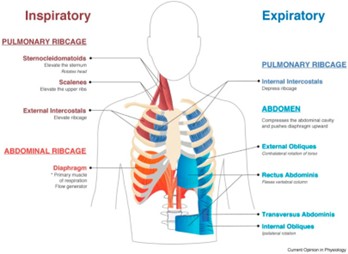
During quiet, relaxed breathing, your main “in-breath” muscle is the diaphragm, a dome-shaped muscle sitting under your lungs. When it contracts, it creates a vacuum effect that draws air into the lungs.
The external intercostal muscles (the muscles between your ribs) also help by lifting and expanding the ribcage, giving your lungs more room to fill.
Breathing out at rest is mostly passive. Those muscles relax, and the natural elastic recoil of the lungs helps push air back out.
What changes when you exercise?
When you exercise, your muscles need more oxygen, and you produce more carbon dioxide. So, your breathing must get deeper and more efficient.
To help you breathe in more air, your body recruits accessory breathing muscles such as:
- Scalenes
- Sternocleidomastoid (the big neck muscle)
- Upper trapezius
- Chest muscles
These lift the upper ribs and breastbone to expand the chest even further.
Breathing out during exercise becomes more active too, using your abdominal muscles:
- Rectus abdominis (your “six-pack”)
- External obliques
- Internal obliques
- Transversus abdominis
All that extra muscle activity is one of the reasons you burn significantly more calories exercising than you do at rest.
The best way to breathe is…
Once you know how breathing works (and how much it influences your health), it’s natural to wonder: is there a “best” way to do it?
As always, the honest answer is: it depends.
It depends on how well you’re currently breathing.
If you do yoga, tai chi, or Pilates, there’s a good chance you already have decent breathing habits because breathwork is built into the practice.
If you have a medical condition that affects breathing, asthma, COPD, heart failure, and so on, some of what I’m about to cover may still be helpful, but please speak to your medical practitioner first.
If you search online for “how to breathe properly”, you’ll quickly find contradictory advice.
The most common debate is usually belly (diaphragmatic) breathing versus chest breathing.
Like most things in the body, it’s more nuanced than “this is good, that is bad”. But for most people, belly breathing tends to be the more efficient default.
Chest breathing vs belly breathing
Chest breathing
This is where you inhale your diaphragm contracts, your chest expands outwards, your shoulders move upwards, and your body lengthens. As you exhale your chest contracts, shoulders come down, and your accessory muscles relax.
The problem is that chest breathing often relies heavily on those accessory muscles, and they’re not designed for regular, all-day breathing.
If you’re constantly using them, they can become overworked and tight. Over time that can contribute to:
- Tight shoulders
- Neck pain
- Headaches
There’s also a nervous system angle. Increased tone in these muscles can send a signal to your brain that you’re under stress, like you need to run, fight, or freeze. If your body stays in that “on edge” state for long periods, it can drain your energy reserves.
Chest breathing can also limit how much your lungs expand, leading to shallower breaths. That can reduce oxygen intake and increase carbon dioxide levels, which adds to metabolic stress.
Belly breathing
During this type of breathing when you inhale your diaphragm contracts, your belly moves outward and your lungs expand. There is nothing wrong with some chest movement as long as the accessory muscles are not involved. During exhalation, your diaphragm relaxes, your belly goes inward, and your external intercostal muscles relax letting your rib cage contract.
Research has linked belly breathing with benefits such as:
- Reduced blood pressure
- Reduced heart rate
- Reduced anxiety
Overall, I couldn’t find reports of negative effects from belly breathing, but there are plenty of potential downsides to chronic chest breathing.
So, if you’re thinking, “How do I breathe… and if I’m a chest breather, can I change it?” the answer is (you guessed it): it depends.

Changing the way you breathe
If you’re mostly a chest breather, the good news is yes, you can change it.
The not-so-good news is that it’s not an overnight fix. Breathing is a habit you repeat up to 20,000 times a day, and it’s largely unconscious.
But if you like a challenge, you can start reprogramming your breathing with a bit of daily practice. Aim for 5–10 minutes, three to four times a day:
- Lie on your back with your knees bent and a pillow under your head or sit upright with your feet flat on the floor.
- Place one hand on your upper chest and one on your abdomen, just below your ribcage.
- Inhale slowly through your nose.
- Focus on feeling your abdomen rise under your lower hand.
- Your top hand may move a little at first, but most of the movement should come from the lower hand.
- Exhale through your nose, feeling your abdomen fall while your chest stays relatively still.
At the start, you’ll need to think about every breath, but as with any habit, it gets easier with repetition.
As always, there are exceptions. If you practice yoga, you may not want to change your breathing style in certain contexts. Some yoga practices use a form of chest breathing that’s linked to energy flow rather than the Western physiological model.
That type of chest breathing is different from the stressed, accessory-muscle-heavy pattern I described earlier, and it avoids many of the issues that can come with overuse of the neck and shoulder muscles.
If you’d like, in Part 2 we can look at why people become chest breathers in the first place, what it can mean for pain and posture, and how to spot what your own breathing pattern is doing day to day.
I hope you found this article useful.
You can always get in touch if you have any concerns for yourself for someone you know.