
Chronic Pain With a “Clear” Scan: What to Do Next
If you have been in pain for months, you are not alone in feeling confused (and frankly fed up) when a scan comes back “normal”. It can feel like you have done the right thing, you have followed the process, and yet you are no closer to an answer.
The good news is that a clear scan does not automatically mean “nothing is wrong”. It often means the next step is to zoom out, review the working diagnosis, and look at other possible drivers of your symptoms.
This blog walks you through practical next steps if you are stuck with persistent pain and no clear explanation.
What counts as chronic pain
In clinical terms, pain is often grouped into two broad categories
- Acute pain is pain that has lasted less than 12 weeks
- Chronic pain is pain that has lasted 12 weeks or more
That time marker matters because the longer pain has been around, the more important it becomes to step back and look at the bigger picture, not just the immediate symptoms.
Why a scan can be clear even when the pain is real
One of the most important takeaways is this.
- Scans can be useful to confirm a suspected diagnosis
- Scans are not always reliable for creating a diagnosis on their own
In other words, a scan can support what a clinician already suspects, but a clear scan does not automatically mean “nothing is wrong”. People can have significant pain even when imaging does not show an obvious structural issue.
If you do have symptoms that match a clear finding on a scan (for example, pain patterns that fit with nerve irritation), imaging can be helpful. But if your scan comes back clear, it is a sign that the original working theory may need to be reviewed.
What should happen next: a differential diagnosis
If a scan does not explain your symptoms, the next step should be further investigation, not resignation.
A structured approach clinicians use is called a differential diagnosis. That simply means.
- List a handful of plausible causes
- Start with the most likely
- Try an appropriate treatment or investigation
- If there is no meaningful change, move to the next possibility
If you are not improving, it is reasonable to expect your care plan to evolve. If it stays the same despite no progress, you can (and should) ask why.
What to do if you are not making progress
If you are in chronic pain, your scan is clear, and you are not improving, the advice is straightforward.
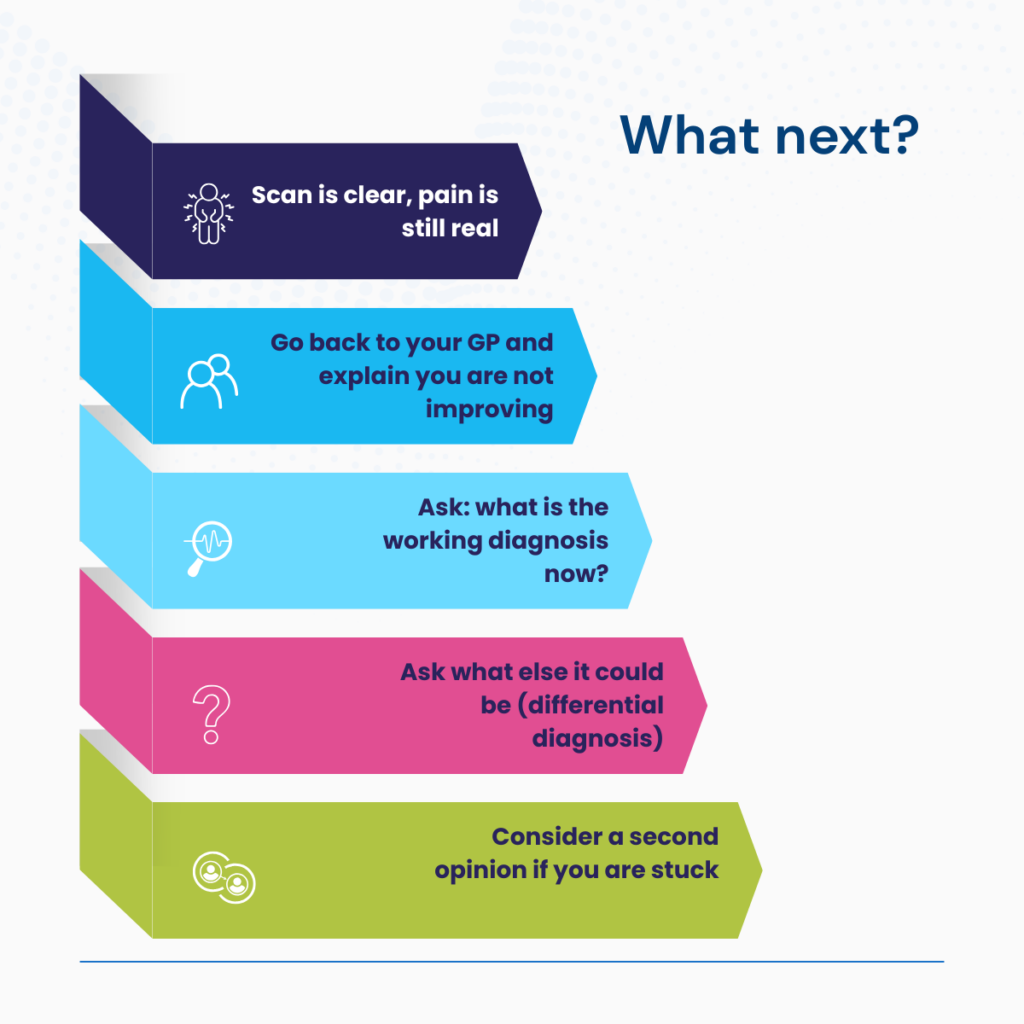
Many people hesitate because they do not want to be seen as difficult. But you live in your body every day. If the pain is still there, it is appropriate to keep asking questions.
Pain medication: useful, but usually not the whole answer
Pain medication can have a place, especially if it reduces pain enough to help you move more comfortably.
- If pain relief helps you move more, that can support recovery
- Movement is important, but it should be within your limits
- Medication is typically a short-term measure, not a long-term solution on its own
The key distinction is that medication can reduce symptoms, but it does not necessarily address what is driving the pain in the first place.
Polypharmacy: when the “solution” becomes part of the problem
An important issue, particularly for older adults, is polypharmacy, meaning taking multiple medications at once.
This can happen when.
- A pain medication causes a side effect
- Another medication is added to manage that side effect
- Additional medications are then added to manage further side effects
Over time, people can end up on several medications, and interactions between them can create new problems. More medication is not always the best next step.
Who to speak to about medication interactions
If you are on multiple medications, and you are worried that side effects or interactions may be contributing to how you feel, a pharmacist can be a strong ally.
- Medication lists should be reviewed periodically (often every 6 to 12 months)
- Pharmacists have specialist training in medication interactions
- Speaking to a pharmacist can be quicker than getting a GP appointment
- A pharmacist can raise recommendations back to your GP if needed
If something feels off after a medication change, it is worth getting that checked properly.
Second opinions and specialist input
If you are not improving, you are allowed to ask for a second opinion (or even a third). A clear scan and ongoing pain is not a reason to stop investigating.
From an osteopathic perspective, it can be appropriate to write to a GP or consultant to recommend further investigation if there is a concern that something has been missed. One practical advantage of a longer appointment is that it can allow for a more thorough history and examination.
A simple takeaway
If you have had pain for 12 weeks or more, your scan is clear, and you still do not have answers.
- Keep asking questions
- Ask what else could explain your symptoms
- Request a review of the working diagnosis
- Do not accept “nothing is wrong” if your experience says otherwise
If you would like support narrowing down what might be going on, I offer a free 15-minute assessment, and happy to have an initial conversation to help you decide on next steps.
I hope you found this article useful.
You can always get in touch if you have any concerns for yourself or someone you know.