
How to Get More from Your Medical Appointment
If there is a pain problem, chances are there will be an appointment with someone in healthcare at some point. That might be a GP, a consultant, or someone privately.
A common issue is this: people leave an appointment with a label for what is going on, but still do not really know what it means for them.
Words like “sciatica”, “frozen shoulder”, or “osteoarthritis” get used a lot. Those labels can be helpful, but only if someone takes the time to explain what is actually happening in the body and what the next steps are.
The problem with jargon
Medical language can be confusing at the best of times. And when someone is in pain, stressed, or worried, it is even harder to take things in.
It is very common to sit in a consultation, nod along, and say, “Yes, I understand.” Then to walk out and think, “I have no idea what they just told me.”
That is not a personal failure. It is simply what happens when information is delivered too quickly, with too many unfamiliar terms.
A good appointment should not feel like someone talking at a patient. It should feel like a conversation where what is happening is clear, and the plan makes sense.

edical appointment should be a two-way thing
Treatment works best when it is a team effort. It’s not just something being ‘done’ to a patient. The best outcomes usually happen when the person being treated understands what is going on and is involved in the process.
That applies whether the appointment is with a GP, consultant, physio, osteopath, or anyone else.
Here are a few simple ways to make the next appointment more useful.
1. Take someone with you if possible
If there is the option, bring someone along.
While trying to listen, think, and answer questions, it is very easy to miss details. A second person can:
- Help remember what was said
- Take notes
- Ask questions that might not come to mind in the moment
Afterwards, notes can be compared to make sure the message is clear.
2. If going alone, ask to record or take notes
For solo appointments, ask if it is okay to record it on a phone. If it’s not appropriate, take notes.
Things are unclear; it’s completely fine to pause and say:
- “Can I just write that down?”
- “What was that term you used?”
- “Can you explain that in a different way?”
It is allowed to take it at a sensible pace.
3. Ask questions, then ask again if it still does not make sense
If something is not understood, ask.
If it is repeated and still does not make sense, ask again.
A professional who understands what they are talking about should be able to explain it in plain English. If it cannot be explained simply, there is a chance it is not fully understood.
And if someone is not willing to explain it, that is a red flag.
4. Keep a simple symptom diary before the appointment
This does not need to be fancy. A few notes on a phone is enough.
Write down things like:
- What makes the pain worse (stairs, driving, sitting, standing)
- What makes it better (rest, movement, heat)
- When it is at its worst (morning, evening, after work)
- How long has it been going on
This helps the person being seen build a clearer picture.
It also helps because in a 10-to 15-minute appointment, it is easy to forget the details.
5. Ask about the plan, not just the label
If medication or a treatment plan has been suggested, it is worth asking what the goal is.
For example:
- “What is the goal of this medication?”
- “How long should it take before there is a difference?”
- “What happens if it does not help?”
- “Are there alternatives?”
And if something has been tried for a few weeks and it is not making a difference, that needs to be said.
That is not being difficult. That is being proactive.
If there is no clarity, consider a second opinion
Anyone in healthcare who is worth their salt will take the time to explain what is going on and answer questions.
If appointments feel rushed, confusing, or dismissive every time, it may be time to speak to someone else.
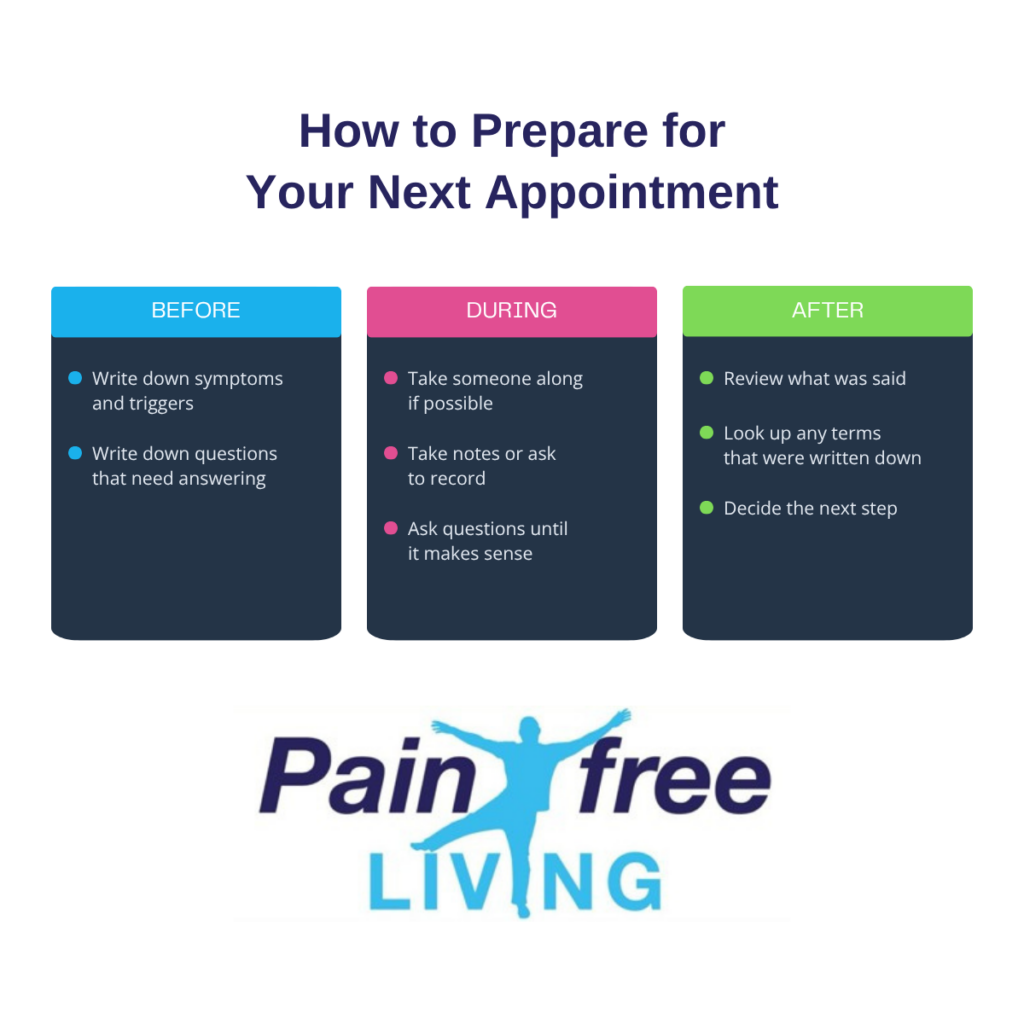
If you have a medical appointment coming up and confidence is low, starting with these basics can make a big difference.
And if you know someone in that situation and are still thinking, “I do not really know what is going on”, this is worth sharing with them.
I hope you found this article useful.
You can always get in touch if you have any concerns for yourself or someone you know.